















Acceptance and Commitment Therapy, or ACT, is an evidence-based therapy that helps you build psychological flexibility.
Psychological flexibility is the ability to stay present, make room for difficult thoughts and feelings, and take action guided by what matters to you.
Many of us wait until we feel better before we take action. We try to get rid of anxiety, quieten the inner critic, stop overthinking, or push difficult feelings away. While these strategies can bring short-term relief, they can also leave you caught in a struggle with your own mind.
ACT offers a different way of responding. Instead of trying to eliminate every uncomfortable thought or feeling, it helps you relate to them differently, so they have less control over the choices you make.
That is one of the most common misconceptions about ACT. Acceptance does not mean resigning yourself to suffering, pretending things are fine when they are not, or letting life happen to you.
It means stopping the exhausting struggle against your own inner life.
When you make room for difficult thoughts and feelings rather than fighting them, they can begin to lose their grip. You stop organising your life around avoiding them, and you begin to have more space to move towards the things that actually matter to you.
That is psychological flexibility, and it is a skill you can build.
ACT develops psychological flexibility through six interconnected skills. These skills guide the way we work in therapy, rather than being something you need to study or get right. We explore and practise them gradually through the therapy process, helping you respond differently to difficult thoughts, feelings, sensations, and situations.
Together, they help you stay present, open up to what is happening, step back from unhelpful mental patterns, reconnect with what matters, and take meaningful action.
Psychological flexibility is the ability to stay connected to the present moment, make room for difficult thoughts and feelings, and keep taking steps towards what matters, even when things are hard.
It is not about being positive all the time or having your life perfectly together. It is about becoming less pulled around by avoidance, overthinking, old habits, or emotional struggle, so you have more choice in how you respond.
Research consistently links higher psychological flexibility with better mental health and wellbeing, while lower psychological flexibility is associated with anxiety, depression, burnout, chronic pain, and stress-related difficulties. Building psychological flexibility can support meaningful, lasting change.
The six skills of ACT all work towards this. Mindfulness, acceptance, defusion, the observing self, values, and committed action are not ends in themselves. Together, they help psychological flexibility grow in a practical, everyday way.
Acceptance and Commitment Therapy often provides the main framework for my work. It gives therapy a clear direction as we build psychological flexibility, helping you be more present, make room for difficult thoughts and feelings, and take action guided by what matters to you.
Depending on what you bring to therapy, I may also draw on mindfulness practices, behavioural strategies, coaching psychology, and Cognitive Behavioural Hypnotherapy. These are not mixed together for the sake of it. Each part is chosen with care, so our work remains practical, evidence-based, and genuinely useful for you.
ACT can be helpful when anxiety, pain, stress, self-doubt, or avoidance have started to make life feel smaller or more restricted. In my work, I often use ACT to support people with:
anxiety
ACT can help you change your relationship with anxious thoughts, physical sensations and the urge to avoid. Instead of waiting until anxiety disappears, we work on building the skills to move towards the life you want with more confidence & choice. Helping you when anxiety has started to shape decisions or make life feel smaller.
stress
When life feels relentless, ACT helps you notice what is pulling you into overthinking, pressure, people-pleasing or running on empty. We focus on responding more flexibly, reconnecting with what matters, and taking practical steps that support your wellbeing.
sleep
ACT can be useful when sleep has become something you are fighting with. Rather than trying harder to force sleep, we look at sleep effort, worry, frustration and the habits that keep the struggle going, so you can build a healthier relationship with rest and sleep.
chronic pain
ACT can help you change how you respond to chronic pain, so pain takes up less of your life. We work with pain-related thoughts, fear, avoidance, frustration and loss, while gently building practical steps back towards the people, roles and activities that matter.
What you are experiencing may not fit neatly into one of these areas, and that is absolutely fine. ACT can also be helpful for:
01
book a free consultation
A relaxed 30-minute call to talk through where things are right now, what you are hoping to change, and whether working together feels right. You can ask questions, get a sense of how I work, and take time to decide what you would like to do next.
02
in-depth assessment
Your first full session is 90 minutes. We take time to understand what you are experiencing, what matters to you, what has been getting in the way, and what you would like therapy to help with. By the end, we have a clearer picture to work from.
03
a personalised plan
After your assessment, we agree a plan for therapy together. This includes what we will focus on, how we will work together, and what may be helpful to practise or reflect on between sessions, so the process feels clear, practical, and purposeful.
04
sessions to fit your life
We can meet online or in person in North Warwickshire, near Tamworth, Ashby-de-la-Zouch and Burton upon Trent, whichever suits you best. Between sessions, the Your Mind Works app keeps your practices, audios and tools to hand, whenever you need them
I offer Acceptance and Commitment Therapy online across the UK, so you can access support from a private space that feels comfortable for you.
If you are based locally, in-person sessions are also available from North Warwickshire. My practice is near the Staffordshire, Derbyshire, and Leicestershire borders, with clients often coming from nearby areas including Tamworth, Burton upon Trent, Ashby-de-la-Zouch, Lichfield, Nuneaton, Atherstone, and the surrounding Midlands.
Whether we work online or in person, the focus is the same: helping you build psychological flexibility and develop practical skills you can use in everyday life.
If you are unsure whether online or in-person sessions would suit you best, we can talk this through during your free consultation.
Lucy Mundy
Your Mind Works
MSc, BSc (Hons) Psychology, HDipCBH, DipSMRB, GMBPsS, MNCIP (reg)
psychologist, integrative psychotherapist + coach
Acceptance and Commitment Therapy, or ACT, is an approach I value deeply because it is both compassionate and practical. It does not ask you to force yourself to think positively, pretend things are fine, or wait until you feel completely better before life can begin again. Instead, ACT offers a way to relate differently to difficult thoughts and feelings, so they have less control over the choices you make.
In my work, ACT provides a strong foundation within an integrative approach. We may also draw on mindfulness, behavioural strategies, coaching psychology, or Cognitive Behavioural Hypnotherapy where helpful, but the focus remains on making therapy useful, grounded, and practical.
My aim is to make complex psychological ideas easier to understand and usable in everyday life, so therapy feels clear, relevant, and supportive.
You do not have to have everything figured out before you begin. Most people start with a feeling that something needs to change, and that is enough.
Because life starts when your session ends.
ACT is most helpful when it becomes something you can return to in everyday life, not just something we talk about in a therapy session.
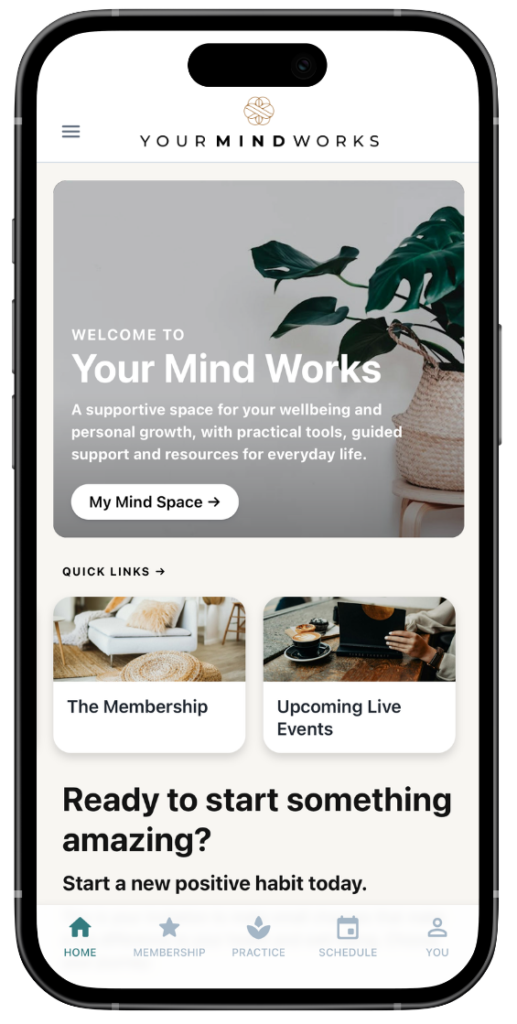
You will have your own private space inside the Your Mind Works app, where I share personalised resources to support what we discuss and practise in sessions. This might include:
Our web-based app means you can easily access on any device with no app store download.
Additional resources, audios and more.
Schedule practices and exercises in your calendar
Your Personal Client Space
Join me for live group sessions inside The Membership
Library full of resources, mind tools, practices and audios.

Your Mind Works web-based app is available on your Apple and Android devices, or easily accessed on your browser and even on your TV.
Psychological flexibility is the ability to stay present, make room for difficult thoughts and feelings, and take action guided by what matters to you.
It does not mean feeling calm, confident, or positive all the time. It means having more choice in how you respond, even when anxiety, stress, pain, self-doubt, or difficult emotions are present.
Acceptance and Commitment Therapy, or ACT, is an evidence-based psychological therapy. It sits within the wider cognitive behavioural family of therapies, which includes approaches such as CBT. ACT is sometimes described as a “third wave” behavioural therapy because it places more emphasis on mindfulness, acceptance, values, and changing how you relate to thoughts and feelings.
Rather than focusing on getting rid of every difficult thought or feeling, ACT helps you change how you relate to them. In therapy, we use skills such as mindfulness, acceptance, defusion, the observing self, values, and committed action, so your life can become less shaped by avoidance and more guided by what matters to you.
ACT includes mindfulness, but it is not the same as mindfulness alone.
In ACT, mindfulness helps you notice thoughts, feelings, sensations, and urges with more awareness and steadiness. Rather than getting caught up in every thought or trying to push feelings away, you learn to create a little more space around what is happening inside.
ACT then goes further by connecting this awareness with values and action. The aim is not just to feel calmer in the moment, but to respond with more choice and move towards the kind of life you want to live.
No. You do not need to know anything about ACT before starting therapy.
ACT ideas are introduced gradually and practically through the therapy process. You do not need to study the six core processes, understand the terminology, or get anything “right” before we begin.
My aim is to make ACT clear, accessible, and usable in everyday life. We explore the ideas through conversation, reflection, exercises, and practice, so they become something you can actually use rather than something you have to learn like a theory.
ACT sits within the wider cognitive behavioural family of therapies, alongside approaches such as CBT, but it has a different emphasis.
Traditional CBT often helps you identify, test, or challenge unhelpful thoughts. ACT focuses more on changing your relationship with thoughts, so you can notice them, step back from them, and choose how to respond. The aim is not to win an argument with your mind, but to build psychological flexibility and take meaningful action guided by what matters to you.
An ACT session is not about being taught a theory or being told to think differently. We usually begin by looking at what has been happening for you, where you feel stuck, and what you would like therapy to support.
From there, we may explore how thoughts, feelings, sensations, or urges are affecting your choices, and practise ways to respond with more awareness and flexibility. This might include mindfulness, defusion exercises, values work, practical reflection, or small steps to try between sessions.
The aim is to make ACT feel useful in real life, so you leave with a clearer understanding of what is happening and practical ways to respond differently.
ACT can be helpful for a range of experiences where difficult thoughts, feelings, sensations, or avoidance have started to shape your life more than you would like.
In my work, I often use ACT to support people with anxiety, stress, overthinking, low mood, self-doubt, sleep difficulties, chronic pain, long-term conditions, burnout, and life transitions.
ACT is not about trying to get rid of every difficult thought or feeling. It helps you build psychological flexibility, so you can respond with more awareness and choice, and take steps towards what matters to you.
This varies depending on what you are coming to therapy for, how long it has been affecting you, and what kind of support will be most useful.
Most people begin with a programme of around six sessions, starting with a 90-minute in-depth assessment. We review progress as we go, so therapy stays relevant, focused, and useful.
Yes. I offer Acceptance and Commitment Therapy online across the UK, so you can access support from a private space that feels comfortable for you.
Online sessions can be especially helpful if you need therapy to fit around work, family, health, or everyday life. If you are unsure whether online or in-person sessions would suit you best, we can talk this through during your free consultation.
Yes. I offer Acceptance and Commitment Therapy in Warwickshire, with in-person sessions available from North Warwickshire. I also offer online sessions across Warwickshire and the wider UK.
I am based near the Staffordshire, Derbyshire, and Leicestershire borders, with clients often coming from nearby areas including Atherstone, Nuneaton, Tamworth, Burton upon Trent, Ashby-de-la-Zouch, Lichfield, and the surrounding Midlands.
Between sessions, you will have access to your own private space inside the Your Mind Works app, where I share personalised resources linked to what we discuss and practise in therapy.
This may include guided ACT practices, mindfulness audios, values exercises, journaling prompts, breathing and grounding practices, and personalised notes or resources to help you build on the therapy session in everyday life.
The app is not a replacement for therapy, but a simple place to return to the ideas, practices, and resources that support your sessions.
Therapy packages start from £600 for six sessions, including a 90-minute in-depth assessment. Payment plans are available.
I work through therapy packages because they give us enough time to understand what is happening, begin building practical skills, and review what is changing over time. The first step is a free 30-minute consultation, where we can talk through what you need and whether working together feels right.
Yes. Acceptance and Commitment Therapy can be helpful for young people and adolescents, especially when they are struggling with anxiety, stress, low confidence, overthinking, emotional overwhelm, pain, sleep difficulties, or feeling stuck.
ACT can support young people to understand what is happening in their mind and body, respond differently to difficult thoughts and feelings, and take small steps towards the things that matter to them.
I have specialist training in ACT for adolescents, along with over 15 years’ experience working with young people and teenagers, including those with special educational needs and disabilities (SEND), anxiety, low confidence, emotional overwhelm, and other challenges that can affect everyday life.
In therapy, the ideas are adapted to the young person’s age, needs, and situation. The focus is on making ACT practical, accessible, and relevant to everyday life, rather than something that feels abstract or overly clinical.
Discover therapy
You do not need to have everything figured out before we speak. The free 30-minute consultation is a chance to talk through what you would like to be different, ask any questions, and get a sense of whether my approach feels right for you.
Research and further reading
The following peer-reviewed research supports the use of Acceptance and Commitment Therapy across a range of presenting difficulties.
The ACT model
Hayes SC, Luoma JB, Bond FW, Masuda A, Lillis J. (2006). Acceptance and commitment therapy: model, processes and outcomes. Behaviour Research and Therapy, 44(1), 1-25. read here (PMID: 16300724)
Psychological flexibility and ACT as a model
Macri JA, Rogge RD. (2024). Examining domains of psychological flexibility and inflexibility as treatment mechanisms in ACT: A comprehensive systematic and meta-analytic review. Clinical Psychology Review, 110, 102432. read here (PMID: 38615492)
Anxiety and depression
A-Tjak JGL et al. (2015). A meta-analysis of the efficacy of acceptance and commitment therapy for clinically relevant mental and physical health problems. Psychotherapy and Psychosomatics, 84(1), 30-36. read here (PMID: 25547522)
López-Pinar C et al. (2025). Process of change and efficacy of ACT for anxiety and depression symptoms in adolescents: A meta-analysis of randomised controlled trials. Journal of Affective Disorders, 368, 633-644. read here (PMID: 39303882)
Zhao B et al. (2023). Effect of acceptance and commitment therapy for depressive disorders: a meta-analysis. Annals of General Psychiatry, 22(1), 34. read here (PMID: 37679716)
Chronic pain
Hughes LS et al. (2017). Acceptance and Commitment Therapy for chronic pain: A systematic review and meta-analyses. Clinical Journal of Pain, 33(6), 552-568. read here (PMID: 27479642)
Martinez-Calderon J et al. (2024). ACT for chronic pain: An overview of systematic reviews with meta-analysis of randomised clinical trials. Journal of Pain, 25(3), 595-617. read here (PMID: 37748597)
Further reading
Harris, R. (2007). The Happiness Trap: Stop Struggling, Start Living. Exisle Publishing. Available at thehappinesstrap.com