

hypnotherapy for anxiety online + warwickshire
Therapy for anxiety
Anxiety can keep you living ahead of yourself. This is where calm, confidence, and more freedom in everyday life begins.
hypnotherapy for anxiety
Keeping it together, but quietly convinced it's all about to fall apart.
You may look like you have it together, and most of the time, you do. But underneath, anxiety can feel relentless. The conversation you are still replaying hours later. The decision that feels harder than it should. The sense that even on a good day, something could be about to go wrong.
Anxiety is not always loud. For many people, it is a constant background hum that shapes what they do, what they avoid, and how much energy they have left at the end of the day.
Anxiety is a normal part of being human, and it is not a sign that something is wrong with you. But when it starts making decisions for you, narrowing your life, or leaving you always on alert, it is worth taking seriously.
Therapy for anxiety is not about waiting for anxiety to disappear before you can start living more fully. It is about understanding what your mind and body are doing, building the skills to respond differently, and changing your relationship with anxiety so it no longer gets to decide what you do.

When your mind works with you instead of against you, everything changes.
understanding how anxiety works
What is Anxiety?
Anxiety is your mind and body’s way of trying to protect you. It can help you pay attention, prepare for something important, or respond quickly when something feels uncertain or risky.
This response can be useful. But anxiety can also become overactive, especially when your mind keeps scanning for what could go wrong, replaying what has already happened, or trying to solve things that cannot be fully solved in advance. Your body may feel as though it needs to act now, even when there is no immediate danger.
Anxiety can show up in different ways. For some people, it feels like racing thoughts, overthinking, panic, physical tension, a tight chest, digestive symptoms, poor sleep, reassurance-seeking, or avoiding situations that feel uncomfortable. For others, it is quieter but constant: a background sense of unease, pressure, or dread that never fully switches off.
Anxiety is a protective response, even when it starts to feel exhausting or out of proportion. But when it becomes too frequent, too intense, or too controlling, it can start to shape your choices, drain your energy, and make everyday life feel harder than it needs to.

anxiety and stress symptoms
Anxiety and stress
Stress and anxiety are closely related, but they are not exactly the same. Stress is usually a response to pressure, demand, or something happening in your life. This might be workload, relationship strain, health worries, financial pressure, or a difficult conversation. It makes sense in context, even when it feels overwhelming.
Anxiety is more anticipatory. It can keep your mind and body on alert before anything has happened, or after the original pressure has eased. It often brings worry, what-ifs, reassurance-seeking, avoidance, tension, poor sleep, and the sense that you cannot fully switch off.
The two often feed into each other. Stress can make your threat response easier to trigger, and anxiety can make everyday pressures feel harder to handle. Over time, it can feel as though your system never fully settles, even when there is no immediate problem to solve.
Therapy helps by working with both. We look at what keeps your mind and body on alert, build skills to regulate your response, and help you take action based on what matters, rather than what anxiety says is safest.
Anxious and exhausted
Living with persistent anxiety can be mentally and physically draining. Even when you appear to be coping, your mind may be working hard in the background: scanning for problems, replaying conversations, preparing for what might go wrong, or trying to stay one step ahead of everything.
Over time, this can affect concentration, memory, sleep, decision-making, and your ability to feel fully present. You might notice you are more irritable, more sensitive to pressure, less able to switch off, or constantly tired without really knowing why. Anxiety takes energy. When your system is often on alert, it makes sense that you would feel worn down.
Therapy helps you understand what is keeping the anxiety cycle going and build the skills to respond differently. As the struggle with anxiety reduces, many people find they have more space, steadiness, and energy for the things that matter.

When does anxiety become a problem?
Anxiety becomes a problem when it stops being a helpful signal and starts taking up too much space in your life. It can show up differently for different people, but you might recognise some of these signs:
- It limits what you do, such as avoiding situations, declining invitations, putting things off or stepping back from opportunities.
- Your body feels constantly tense, with symptoms such as headaches, muscle tension, digestive problems, poor sleep, or feeling permanently wired.
- Your mind keeps searching for certainty, replaying conversations, imagining worst-case scenarios or trying to prepare for every possible outcome.
- Concentration and decision-making feel harder, so simple tasks take more effort, work feels more difficult than usual, or you find yourself second-guessing things you would normally handle easily.
- Your relationships are affected, perhaps through reassurance-seeking, irritability, withdrawing or finding it hard to be fully present.
- Your emotions feel harder to manage, leaving you on edge, easily overwhelmed, tearful, restless or unable to relax.
- Coping strategies start helping less, such as avoidance, staying busy, over-preparing or seeking reassurance. The relief may be real, but the anxiety often comes back stronger.
If anxiety is starting to shape your life, therapy can help you understand what is happening and build the skills to respond differently.

integrative therapy and hypnotherapy for anxiety
An evidence-based approach
In our sessions, we work collaboratively, bringing together a range of evidence-based approaches to help you create meaningful, lasting change.
Acceptance and Commitment Therapy (ACT) can help you respond differently to anxious thoughts and feelings, rather than feeling as though life has to wait until anxiety disappears. You can learn to notice what is happening in your mind and body, take a step back from unhelpful patterns, and move towards the things that matter to you.
Cognitive Behavioural Hypnotherapy (CBH) uses focused attention, therapeutic suggestion, imagery, mental rehearsal, and self-hypnosis skills. Helping you practise calmer, steadier responses to situations that currently feel difficult or overwhelming. This might include conversations, decision-making, uncertainty, public speaking, social situations, or other experiences where anxiety tends to show up.
Mindfulness can help you feel more grounded when anxiety pulls you into worry, overthinking, or “what if” thoughts. It is not about clearing your mind, but about learning to notice what is happening with more steadiness, so you can respond with greater choice.
Life Beyond Anxiety
How we work together
therapy for anxiety in warwickshire + online

01
book a free consultation
A relaxed 30-minute call to talk through what has been going on, what you are hoping to change, and any questions you have. It is a chance to get a sense of my approach and decide whether it feels like the right next step for you.

02
in-depth assessment
Your first full session is 90 minutes. We take time to understand how anxiety is affecting you, what may be keeping it going, and what you would like to be different. By the end, we have a clearer picture to work from.

03
a personalised plan
After your assessment, we agree a plan for therapy together. This includes what we will focus on, how we will work together, and what may be helpful to practise or reflect on between sessions, so the process feels clear, practical, and purposeful.

04
sessions to fit your life
We meet online or in person, depending on what works best for you. Between sessions, you can use the Your Mind Works app for guided practices, audios, exercises and tools that help you keep building skills in everyday life.


What you can achieve
Your personalised plan.
Anxiety can affect people in different ways, so therapy needs to be personal to you. Together, we focus on how anxiety is showing up in your life, what it’s getting in the way of, and what you would like to feel more able to do. We can work towards helping you:
- Walk into a meeting, presentation or social situation with more steadiness, even if anxiety is still present.
- Make decisions based on what matters to you, rather than what feels safest.
- Leave a conversation without replaying it for hours afterwards.
- Take steps you have been putting off until you feel completely ready.
- Recognise anxious thoughts as just thoughts, not facts.
- Handle uncertainty with less reassurance-seeking and more self-trust.
- Build confidence in your ability to cope whatever comes your way.
- Spend less energy managing anxiety and more energy living your life.
Kind Words
therapy for anxiety life beyond anxiety
Lasting change takes more than one conversation. That’s why therapy for anxiety usually works best when there is enough time to understand what’s keeping anxiety going, build the right skills, and practise using them in everyday life, not just in the therapy room.

Your programme includes:
Session 1 In-depth assessment (90 mins):
We map out what has been happening, how anxiety is affecting your life, what may be keeping it going, and what you would like to be different.
Sessions 2 - 6 (60 mins each):
We work with evidence-based approaches including Acceptance and Commitment Therapy, mindfulness, behavioural strategies and Cognitive Behavioural Hypnotherapy. The focus is on understanding how anxiety is affecting you, building practical skills, changing your relationship with anxiety, and helping you take meaningful steps in everyday life.
also included
- A free 30-minute consultation before you begin.
- Sessions online or in person in North Warwickshire, convenient for clients in Tamworth, Ashby-de-la-Zouch and the surrounding Midlands.
- Your private client space inside the Your Mind Works app.
- Personalised audios, exercises and resources between sessions.
- Six months’ access to The Membership, with additional resources, live sessions and workshops.
6 session programme: £600
This includes your 90-minute in-depth assessment, followed by five 60-minute sessions.
You can pay in full, or split the cost into two monthly payments of £300. Booked individually, the same sessions would cost £750, so this option saves you £150 compared with paying session by session.
Individual session rates
90 minute assessment: £150
60 minute therapy session: £120
your mind works app
SUPPORT between sessions
Because life starts when your session ends.
You will have your own private space inside the Your Mind Works app, where I share personalised resources to support what we discuss and practise in sessions.
This might include guided audios, exercises, journal prompts, grounding practices, self-hypnosis resources, and reminders of key ideas from therapy.
Alongside your private client space, you also receive six months’ access to The Membership, with live sessions, workshops, guided practices, and additional resources to support your wider wellbeing.
The app is not another thing to keep up with. It is simply a clear place to return to personalised resources from your sessions, whenever you need them.
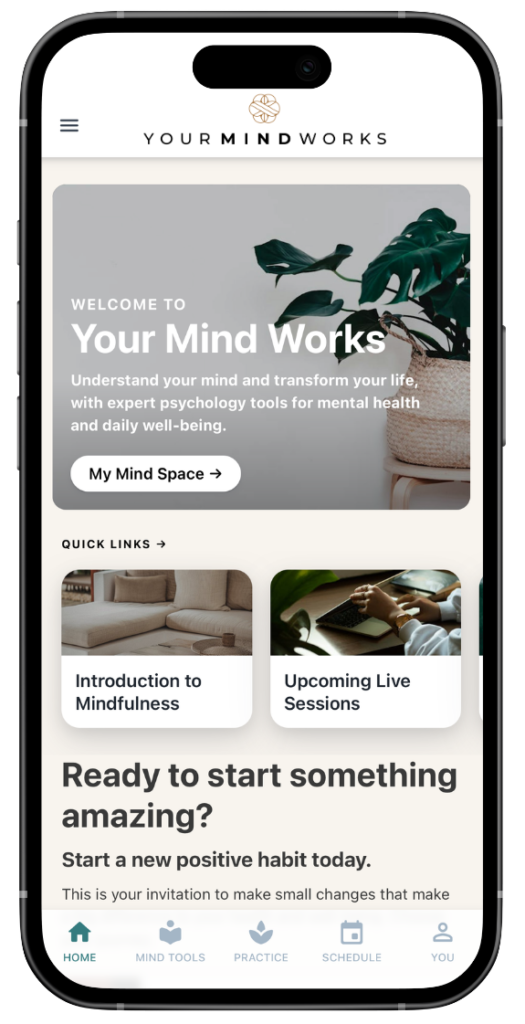
Our web-based app means you can easily access on any device with no app store download.
Additional resources, audios and more.
Schedule practices and exercises in your calendar
Your Personal Client Space
Join me for live group sessions
Library full of resources, mind tools, practices and audios.

Your Mind Works web-based app is available on your Apple and Android devices, or easily accessed on your browser and even on your TV.
Lucy Mundy
Your Mind Works
MSc, BSc (Hons) Psychology, HDipCBH, DipSMRB, GMBPsS, MNCIP (reg)
psychologist, integrative psychotherapist + coach
I know what it feels like to understand something in theory, but still find it difficult to put into practice. That gap between knowing what will help and being able to use it in daily life is often where therapy can make a real difference.
My work brings together psychology, therapy, coaching and mindfulness in a way that is practical, evidence-based and down to earth. I help people make sense of what is happening in their mind and body, build skills that work in real life, and move towards the changes they want to make.
You do not have to have everything figured out before you begin. Many people start with a sense that something needs to change. My aim is to offer a space where you feel heard, understood, and supported, while also helping you develop practical tools and strategies you can use in everyday life.

frequently asked questions
Hypnotherapy can help with anxiety, especially when it is used as part of a clear, evidence-based therapeutic approach rather than as a standalone quick fix.
In my work, Cognitive Behavioural Hypnotherapy combines hypnosis with practical psychological tools to help you understand and respond to anxiety differently. This may include focused attention, guided imagery, therapeutic suggestion, mental rehearsal, and self-hypnosis skills.
For many people, this can support calmer, steadier responses to situations that currently feel difficult or threatening, such as uncertainty, conversations, presentations, social situations, or decision-making.
Hypnosis is not about losing control or being made to do anything. You stay aware, involved, and able to choose how you respond throughout
ACT stands for Acceptance and Commitment Therapy. It is an evidence-based approach that can help you respond differently to anxious thoughts and feelings, so they do not have to control what you do next.
When you are struggling with anxiety, it is natural to try to fight the feelings, push thoughts away, avoid situations, or wait until you feel more confident before taking action. ACT helps you notice these patterns and gently step back from them.
Rather than trying to get rid of anxiety completely, ACT helps you build skills to handle anxious thoughts and feelings while still moving towards the things that matter to you.
Mindfulness can help with anxiety by giving you a little more space between what you notice and how you respond.
When anxiety shows up, it can quickly pull you into worry, overthinking, reassurance-seeking, or physical sensations such as a tight chest, racing heart, or unsettled feeling. Mindfulness helps you notice these thoughts and sensations without being immediately swept along by them.
It is not about emptying your mind or stopping anxious thoughts from appearing. Instead, mindfulness helps you relate to your thoughts and feelings with more steadiness, so you can respond with greater choice rather than reacting automatically.
Hypnotherapy for anxiety starts with understanding how anxiety is affecting you and what you would like to change. We look at how anxiety shows up in your thoughts, body, behaviours, daily routines, confidence, sleep, and the situations that currently feel difficult.
From there, we create a personalised plan for your sessions. Depending on what you need, this may include Acceptance and Commitment Therapy, mindfulness, practical behavioural strategies, hypnosis, guided practice, and tools to use between sessions.
The aim is to help you understand your anxiety more clearly, respond to it differently, and build skills you can use in everyday life, not just in the therapy room.
Yes. Overthinking and worry are common parts of anxiety, and therapy can help you understand what keeps them going.
Your mind may be trying to search for certainty, replay conversations, prepare for every possible outcome, or prevent something from going wrong. While this can feel like problem-solving, it often leaves you feeling more stuck, tense, or exhausted.
Rather than trying to force your mind to stop thinking, therapy can help you respond differently to anxious thoughts, reduce reassurance-seeking, and build more trust in your ability to handle uncertainty.
Yes. Anxiety often shows up in the body as well as the mind. This might include muscle tension, a tight chest, digestive symptoms, headaches, poor sleep, restlessness, panic sensations, or feeling constantly on edge.
Therapy can help you understand these physical anxiety symptoms, feel less frightened by them, and build practical ways to settle, ground, and respond differently when anxiety shows up in your body.
Research suggests that online therapy can to be just as effective as face-to-face therapy for many common concerns, especially when there is a good therapeutic relationship, clear structure, and practical work between sessions.
Some clients prefer meeting online because it feels more comfortable, private, or easier to fit into a busy week. With Your Mind Works, the app also gives you a clear place to revisit practices, reflect between sessions, and build on what we cover in therapy.
If you are unsure whether online or in-person therapy would suit you best, we can talk it through during your free consultation.
This depends on what you are experiencing, how long anxiety has been present, and what kind of support will be most useful.
Most people work with me through a six-session anxiety therapy programme, beginning with a 90-minute in-depth assessment. We review progress as we go, so the work stays focused, relevant and useful.
Yes. I offer hypnotherapy in Warwickshire, with in-person sessions available from North Warwickshire. I also offer online hypnotherapy across Warwickshire and the wider UK.
I am based near the Staffordshire, Derbyshire, and Leicestershire borders, with clients often coming from nearby areas including Atherstone, Nuneaton, Tamworth, Burton upon Trent, Ashby-de-la-Zouch, Lichfield, and the surrounding Midlands.
Yes. I offer anxiety therapy in Warwickshire online and in person from North Warwickshire.
I work with clients across Warwickshire and the surrounding areas, including Tamworth, Atherstone, Nuneaton, Burton upon Trent, Ashby-de-la-Zouch, Lichfield and nearby parts of Staffordshire, Derbyshire and Leicestershire.
Hypnotherapy is a safe, supportive process when it is delivered by an appropriately trained practitioner and used as part of a clear therapeutic approach. In Cognitive Behavioural Hypnotherapy, hypnosis is a focused state of attention, not unconsciousness or loss of control. You remain aware, involved and able to choose how you respond.
However, it is not suitable for everyone. Some mental health difficulties, medical conditions, or issues may need specialist or medical support first. Our initial consultation gives us a chance to talk through what you are looking for, whether hypnotherapy is suitable, and what kind of support would be safest and most helpful.
Yes. Confidentiality is an important part of therapy. Your information and what you share in sessions is treated with care and respect.
There are only very limited exceptions, mainly if there were serious concerns about your safety or the safety of someone else. These situations are uncommon, and wherever possible, I would aim to discuss this with you first.
If therapy has not helped before, it makes sense to feel cautious about trying again. It does not mean therapy cannot help. It may mean the approach, pace, focus, or level of support was not the right fit for you at the time.
Sometimes therapy can focus mainly on talking about anxiety, without enough practical support to help you respond differently in everyday life. My approach is structured and skills-based. We focus on understanding what is happening, building useful tools, and helping you use those skills in the moments that matter.
Therapy packages start from £600 for six sessions, including a 90-minute in-depth assessment. Payment plans are available.
I work through therapy packages because they give us enough time to understand what is happening, begin developing practical skills, and review what is changing over time. Before booking a package, the first step is a free 30-minute consultation, where we can talk through what you need and whether working together feels right.
You do not need to wait until anxiety becomes unbearable before getting support.
If anxiety is affecting your sleep, confidence, work, relationships, decisions, health, social life or sense of freedom, it is worth taking seriously. The free 30-minute consultation is simply a chance to talk about what you would like to be different, ask any questions, and find out whether working together feels like the right fit.
YOUR NEXT STEPS
If you’re curious about whether hypnotherapy for anxiety could help or are unsure where to start, you are welcome to book a free 30-minute consultation. We can talk through what is happening for you, answer any questions, and explore whether this approach feels like the right next step.


References
A-Tjak, J.G.L., Davis, M.L., Morina, N., Powers, M.B., Smits, J.A.J. and Emmelkamp, P.M.G. (2015) ‘A meta-analysis of the efficacy of acceptance and commitment therapy for clinically relevant mental and physical health problems’, Psychotherapy and Psychosomatics, 84(1), pp. 30–36. view here
Godoy, L.D., Rossignoli, M.T., Delfino-Pereira, P., Garcia-Cairasco, N. and de Lima Umeoka, E.H. (2018) ‘A comprehensive overview on stress neurobiology: Basic concepts and clinical implications’, Frontiers in Behavioural Neuroscience, 12. view here
Hofmann, S.G., Sawyer, A.T., Witt, A.A. and Oh, D. (2010) ‘The effect of mindfulness-based therapy on anxiety and depression: A meta-analytic review’, Journal of Consulting and Clinical Psychology, 78(2), pp. 169–183. view here
Kirsch, I., Montgomery, G. and Sapirstein, G. (1995) ‘Hypnosis as an adjunct to cognitive-behavioural psychotherapy: A meta-analysis’, Journal of Consulting and Clinical Psychology, 63(2), pp. 214–220. view here
Moran, T.P. (2016) ‘Anxiety and working memory capacity: A meta-analysis and narrative review’, Psychological Bulletin, 142(8), pp. 831–864. view here
Ramondo, N., Gignac, G.E., Pestell, C.F. and Byrne, S.M. (2021) ‘Clinical hypnosis as an adjunct to cognitive behaviour therapy: An updated meta-analysis’, International Journal of Clinical and Experimental Hypnosis, 69(2), pp. 169–202. view here
Valentine, K.E., Milling, L.S., Clark, L.J. and Moriarty, C.L. (2019) ‘The efficacy of hypnosis as a treatment for anxiety: A meta-analysis’, International Journal of Clinical and Experimental Hypnosis, 67(3). view here