
integrative therapy + hypnotherapy for sleep
therapy for sleep + insomnia
Less struggle at night.
More of yourself for the day ahead.
hypnotherapy for sleep
A good night's sleep can change more than you think.
Imagine waking naturally, just before your alarm. Sunlight filters through the curtains, and the day feels a little easier to meet. You’re not immediately reaching for your phone to calculate how many hours you’ve had or wondering how you’ll make it through the day.
Instead, you feel clearer, more patient and more able to take part in what is happening around you. A better night’s sleep doesn’t solve everything, but it can change how possible the day feels.
Good sleep isn’t just rest. It gives you your life back.


therapy for sleep
When rest feels out of reach
You might lie awake for hours, wake repeatedly during the night, wake far earlier than you want to or sleep without ever feeling properly rested.
Perhaps you’ve tried earlier nights, better routines, fewer screens, relaxation exercises or simply trying harder to switch off. Some things may help for a while, yet sleep still feels unpredictable – and the more you try, the harder it can seem to reach.
After a while, bedtime can begin to feel like something you have to get right. You watch the clock, calculate how many hours are left and wonder how you’ll cope tomorrow. Even before you get into bed, part of you may already be preparing for another difficult night.
Therapy for sleep can help reduce that struggle and support the conditions your mind and body need for rest.

When your mind works with you instead of against you, everything changes.
hypnotherapy for sleep
more than just rest
Understanding Sleep
Sleep is an active process that supports memory, concentration, mood, physical recovery and your ability to cope with the day ahead.
It depends on several things working together, including the pressure to sleep that builds while you’re awake, your body clock and your level of physical and mental alertness. This is why feeling exhausted doesn’t always mean sleep comes easily.
One difficult night is rarely a problem on its own. But when sleep is repeatedly disrupted, the way you respond can begin to affect what happens next.

The cycle of insomnia
Sleep difficulties often begin for understandable reasons. Stress, pain, anxiety, illness, hormones, grief, parenting, work pressure or a change in circumstances can all disrupt your sleep.
When it continues, you may start watching the clock, calculating how many hours are left or trying harder to make yourself switch off. During the day, you might worry about the coming night, go to bed earlier to catch up or arrange more of your life around how tired you feel.
This all makes sense when sleep feels so important. But it can also increase the pressure around it. Bedtime starts to feel like a test, and being awake can feel like a threat. Your mind begins monitoring what is happening and your body remains alert, even though sleep is more likely when that alertness can settle.
Therapy helps you understand what is keeping this cycle going and practise different ways of responding, both during difficult nights and throughout the day.
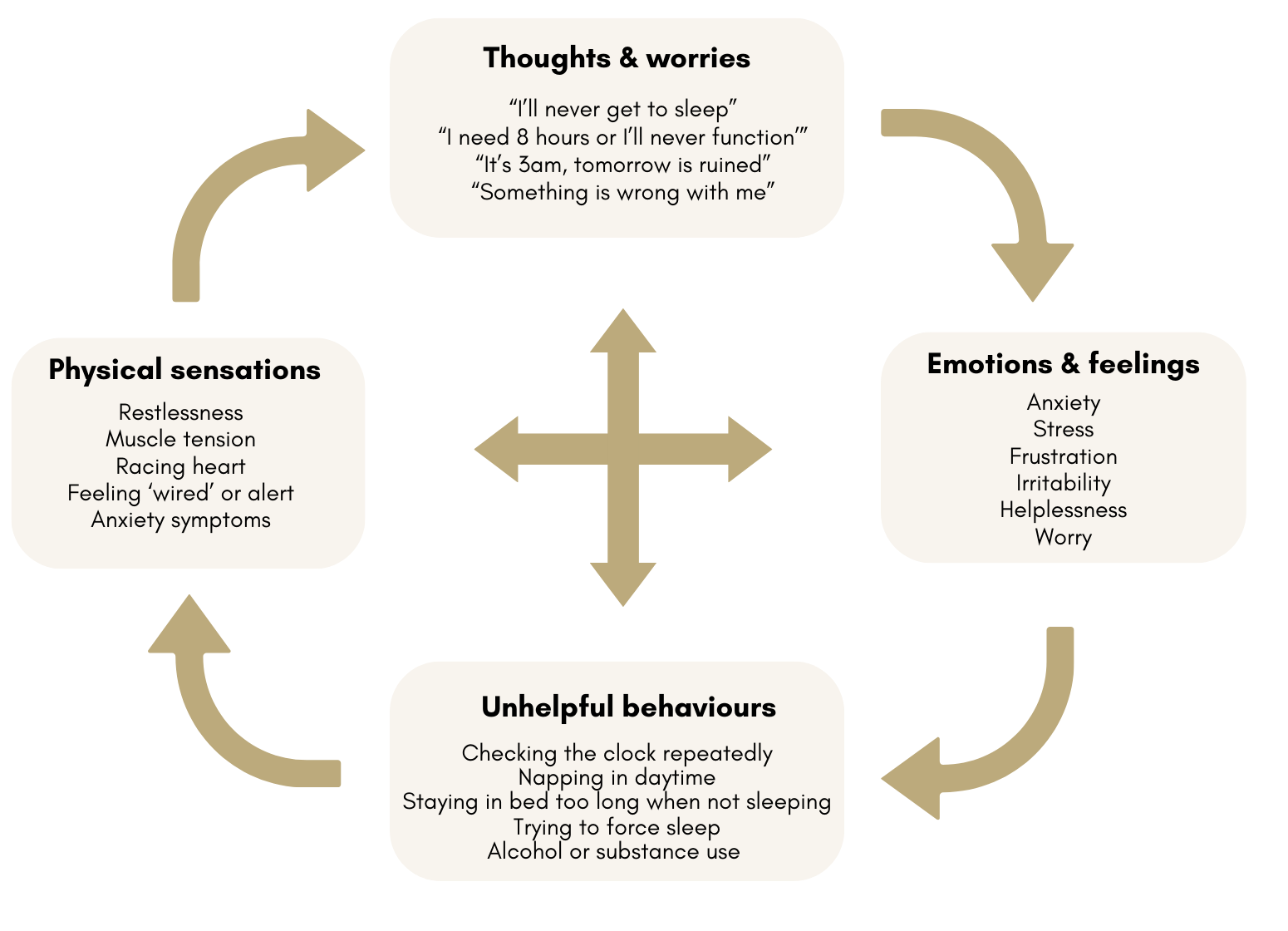
integrative therapy + hypnotherapy for sleep
After a difficult night
Poor sleep can affect far more than how tired you feel. You may notice changes in:
- Concentration and memory – it can be harder to think clearly, focus or make decisions.
- Mood – you may feel more irritable, anxious, tearful or easily overwhelmed.
- Energy and motivation – ordinary tasks can take far more effort than usual.
- Your body – you may feel tense, run down or slower to recover.
- Relationships and daily life – tiredness can make it harder to be patient, present or involved.
That’s why therapy for sleep isn’t only about the number of hours you get. We’ll also look at what may be disturbing your sleep in the first place, help you deal with it differently and reduce the worry, planning and changes to daily life that can build around a difficult night.
ACT, mindfulness + hypnotherapy for sleep
An evidence-based approach
I bring together several evidence-based approaches, choosing each one for a clear reason based on what is distrupting your sleep and what may be keeping the struggle going.
Acceptance and Commitment Therapy (ACT) can help you respond differently to wakefulness, worry and frustration, rather than becoming caught in a battle to make sleep happen.
Mindfulness can help you notice thoughts, physical sensations and urges, such as checking the clock, without immediately reacting to them or making yourself feel even more alert.
Behavioural strategies from Cognitive Behavioural Therapy for Insomnia (CBT-I) can help you understand your sleep pressure and body clock, then make changes to routines or habits that may be affecting your sleep. We use these flexibly, as things to try and learn from rather than another set of sleep rules you have to get right.
Cognitive Behavioural Hypnotherapy uses focused attention, imagery, suggestion and mental rehearsal to help you practise settling and respond more calmly during difficult nights. You can also learn self-hypnosis skills to use for yourself.
The aim isn’t to force sleep or give you another set of rules to follow. It’s to reduce the struggle, work with your natural sleep systems and help rest feel easier again.
A good nights sleep
How we work together
hypnotherapy for sleep online and in warwickshire

01
book a free consultation
A relaxed 30-minute call to tell me a little about what has brought you to therapy and what you’re hoping to change. You can ask questions and find out what the next steps would involve.

02
in-depth assessment
Your first full session is 90 minutes. We explore what you’ve been experiencing, the relevant parts of your history, how things are affecting your life and what you would like therapy to help you change.

03
a personalised plan
After your assessment, we agree what you would like to focus on and how we’ll work together. This gives our work direction while allowing us to review and adapt the plan as things change.

04
sessions to fit your life
We can meet online or in person in North Warwickshire, within easy reach of Tamworth, Ashby-de-la-Zouch and Burton upon Trent. Between sessions, your private space in the Your Mind Works app keeps your practices, audios and resources together and easy to return to.


Your Personalised Plan
What therapy can help change
Your plan will focus on how sleep difficulties are affecting your life and what you would like to be different. Depending on what you need, therapy can help you:
- Understand what is keeping the insomnia cycle going and why trying harder to sleep can sometimes make it worse.
- Feel better able to cope with stress, worry or other difficulties that may be disturbing your sleep.
- Reduce the pressure around bedtime, clock-watching and getting sleep “right”.
- Respond differently when you’re awake at night, without becoming caught in worry or calculations.
- Make changes that support your body clock and natural sleep pressure without turning sleep into another thing to manage perfectly.
- Spend less time arranging your days around tiredness or putting things off after a difficult night.
- Feel more confident in your ability to rest and cope when sleep doesn’t go to plan.
sleep again programme therapy for sleep
Sleep Again is a six-session programme designed to help you reduce the struggle around sleep, rest more easily and have more energy for the life waiting for you during the day.

Your programme includes:
Session 1: In-depth assessment 90 mins
We’ll make sense of what has been happening, how it is affecting you and what you would like to change. From there, we’ll agree where to begin.
Sessions 2 - 6 - 60 mins each
We’ll focus on what will make the most difference for you, with ways to manage difficult nights, cope with tired days and respond differently to stress or worry that may be affecting your sleep.
also included
- A free 30-minute consultation
- Sessions online or in person
- A private client space inside the Your Mind Works app
- Personalised audios, exercises and resources for use between sessions
- Six months’ access to The Membership
six session sleep programme: £600
This includes your 90-minute assessment and five 60-minute sessions. You can pay in full or in two payments of £300.
If booked individually, the same sessions would cost £750, so the programme saves you £150 compared with paying session by session.
Prefer to book session by session?
A 90-minute assessment is £150, and 60-minute therapy sessions are £120.
your mind works app
SUPPORT between sessions
You’ll have your own private space inside the Your Mind Works app, where your personalised resources, guided audios, exercises, journal prompts and practices are kept together and easy to find.
Between sessions, you can return to the ideas we’ve discussed, practise new skills and listen to any audios I’ve chosen or created for you. If it’s helpful, you can also share reflections before we meet, allowing us to use our session time more effectively.
The app is there to support the work we’re doing, not give you more to keep up with. Use what helps, when it helps.
You’ll also receive six months’ access to The Membership, with live member sessions, the growing Practice Library and more ways to look after your wellbeing and keep growing.
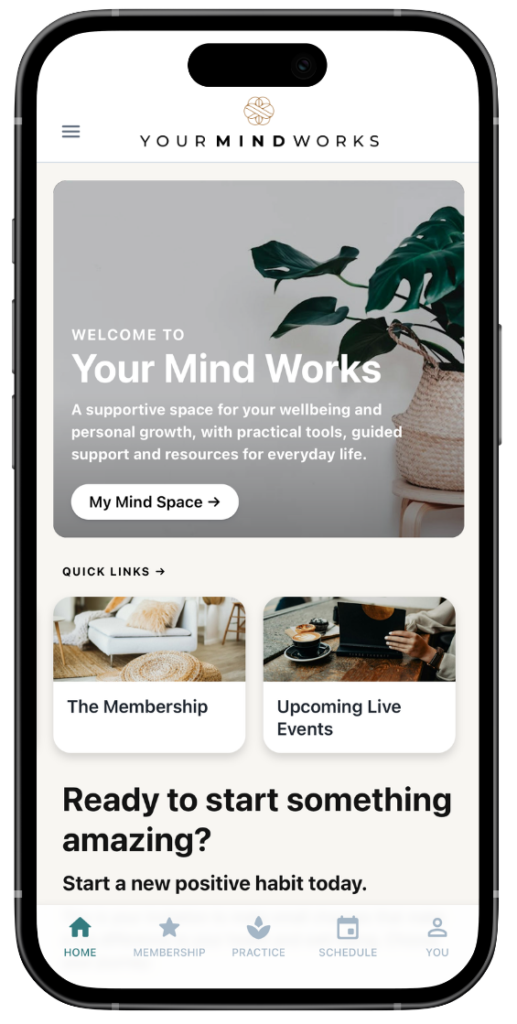
Our web-based app means you can easily access on any device with no app store download.
Additional resources, audios and more.
Schedule practices and exercises in your calendar
Your Personal Client Space
Join me for live group sessions
Library full of resources, mind tools, practices and audios.

Your Mind Works web-based app is available on all your devices. There’s nothing to download from an app store.
Lucy Mundy
Your Mind Works
MSc, BSc (Hons) Psychology, HDipCBH, DipSMRB, GMBPsS, MNCIP (reg)
psychologist, integrative psychotherapist + coach
Psychology has been at the heart of my work for more than 25 years, helping people understand themselves, feel better and make changes that matter in their lives.
My work with sleep brings together Acceptance and Commitment Therapy, mindfulness, Cognitive Behavioural Hypnotherapy and behavioural strategies from CBT-I. This allows us to work with both sleep itself and the stress, worry or other difficulties that may be contributing to it.
I know how quickly sleep can become something you think about all day and struggle with all night. By the time people come to therapy, they have often tried a long list of advice and feel as though they should have been able to solve it themselves.
My approach is warm, engaging and down to earth. We’ll make sense of what is happening, focus on what is most relevant to you and find ways forward that don’t turn sleep into another thing you have to get right. The aim is for you to understand your sleep more clearly and leave with skills you can continue using long after our sessions end.

free guide to understanding sleep + insomnia
Your Guide to A good night's sleep
Learn what affects sleep, why the usual advice isn’t always enough and what you can try when sleep feels difficult.
Inside, you’ll find:
- How sleep works, why sleep problems develop and what can keep them going.
- How sleep can change through different stages of life, including ageing and menopause.
- Ten strategies you can begin trying tonight.
frequently asked questions
There isn’t one type of therapy that is best for everyone with sleep difficulties. We begin by understanding what is affecting your sleep, what may be keeping the difficulty going and how it is affecting your life.
My approach brings together Acceptance and Commitment Therapy, mindfulness, Cognitive Behavioural Hypnotherapy and behavioural strategies from CBT-I. Each has a clear purpose, and I’ll explain what we’re using and why.
Feeling tired doesn’t always mean sleep will come easily. Sleep depends on several things working together, including your natural sleep pressure, body clock and level of physical and mental alertness.
When sleep has become difficult, worrying, clock-watching or trying hard to switch off can leave you feeling more alert. Your body may be exhausted while your mind remains busy trying to solve the problem.
Hypnotherapy can be helpful for sleep when it is used as part of a wider therapeutic approach.
Cognitive Behavioural Hypnotherapy uses focused attention, imagery, suggestion and mental rehearsal to help you practise settling and respond differently when sleep doesn’t come. You can also learn self-hypnosis skills to use for yourself.
You remain aware and involved during hypnosis and can speak, move, pause or stop at any time. Hypnotherapy isn’t suitable for everyone, so we’ll discuss your health and whether it would be appropriate before beginning.
Cognitive Behavioural Therapy for Insomnia, or CBT-I, is a structured approach that uses cognitive and behavioural strategies to change things that may be interfering with sleep.
I use behavioural strategies from CBT-I alongside ACT, mindfulness and Cognitive Behavioural Hypnotherapy. We use them flexibly, as things to try and learn from rather than another set of sleep rules you have to follow perfectly.
This also allows us to work with stress, worry or other difficulties that may be affecting your sleep, as well as what happens around bedtime.
Most people who come to therapy have already tried earlier nights, better routines, fewer screens, relaxation exercises, herbal teas or simply trying harder to switch off.
Once sleep has become something you’re trying to control, more advice and effort can sometimes add to the pressure. Therapy helps you understand what is happening and find an approach based on your sleep and your life, rather than another generic list of rules.
Yes. Online sleep therapy and hypnotherapy are available across the UK, allowing you to join from a private space at home.
In-person sessions are available in North Warwickshire, within easy reach of Tamworth, Ashby-de-la-Zouch and Burton upon Trent.
Most people begin with six sessions: a 90-minute in-depth assessment followed by five 60-minute sessions. The Sleep Again programme costs £600, payable in full or in two payments of £300.
Some people may benefit from further sessions, depending on what they need. We’ll discuss this before beginning and review it together as we go.
You don’t need to wait until sleep difficulties feel unbearable before asking for help.
If sleep is affecting your mood, energy, concentration, work, relationships, health or ability to cope with everyday life, it is reasonable to take it seriously. A free 30-minute consultation gives us a chance to discuss what is happening and what you would like to change.
It is worth speaking to your GP if you have had difficulty sleeping for several months, changes to your sleep habits haven’t helped or poor sleep is making everyday life difficult to manage.
You should also speak to your GP if you have symptoms that could suggest another sleep or medical condition. Therapy can work alongside appropriate medical care, but it isn’t a replacement for medical assessment or treatment.
Kind Words
You don't have to work this out alone at 3am.
A free 30-minute consultation gives us a chance to talk about what has been happening and what you would like to change. You can ask questions, find out more about how I work and discuss what the next steps could look like.

References
Kirsch, I., Montgomery, G. and Sapirstein, G. (1995) ‘Hypnosis as an adjunct to cognitive-behavioural psychotherapy: A meta-analysis’, Journal of Consulting and Clinical Psychology, 63(2), pp. 214–220. view here
Ramondo, N., Gignac, G.E., Pestell, C.F. and Byrne, S.M. (2021) ‘Clinical hypnosis as an adjunct to cognitive behaviour therapy: An updated meta-analysis’, International Journal of Clinical and Experimental Hypnosis, 69(2), pp. 169–202. view here
Further Reading
Kalmbach, D.A., Reffi, A.N., Fresco, D.M., Ruprich, M.K., Drake, C.L. and Ong, J.C. (2023) ‘Mindfulness-based therapy for insomnia alleviates insomnia, depression, and cognitive arousal in treatment-resistant insomnia: A single-arm telemedicine trial’, Frontiers in Sleep, 2. view here
Ruan, J., Chen, S., Liang, J., Mak, Y.W., Ho, F.Y.Y., Chung, K.F., Tong, A.K.K., Zhang, X.L. and Yeung, W.F. (2022) ‘Acceptance and commitment therapy for insomnia and sleep quality: A systematic review and meta-analysis’, Journal of Contextual Behavioral Science, 26, pp. 139–155. view here
Paulos-Guarnieri, L., Linares, I.M.P. and El Rafihi-Ferreira, R. (2022) ‘Evidence and characteristics of Acceptance and Commitment Therapy (ACT)-based interventions for insomnia: A systematic review of randomized and non-randomized trials’, Journal of Contextual Behavioral Science, 23, pp. 1–14. view here
Saldaña, K.S., McGowan, S.K. and Martin, J.L. (2023) ‘ACT as an adjunct or alternative treatment to CBT for insomnia’, Sleep Medicine Clinics, 18(1), pp. 73–83. view here