
HYPNOTHERAPY FOR PAIN RELIEF warwickshire and online
Therapy for chronic pain
Chronic pain can affect your energy, your plans and the way you want to live. Therapy can help you live better and do more of what matters.
hypnotherapy for pain relief
Living with chronic pain asks a lot of you, often more than the people around you can see.
Maybe you’ve stopped doing things you love. Perhaps you start each day by working out what you can manage, or what pain might force you to give up. You’re exhausted not only by the pain itself, but by the constant effort of living with it.
Chronic pain affects more than your body. Over time, it can change how you think, feel, sleep, relate to the people around you and how you see yourself.
Therapy for chronic pain, including hypnotherapy for pain relief, can help you understand what may be happening, find better ways to cope and begin doing more of what pain has been getting in the way of. I can’t promise to cure your pain condition, but therapy can help you work towards a life that doesn’t feel entirely defined by it.
Supporting you to take back more of your life from chronic pain

hypnotherapy for pain relief
the reality of persistent pain
What chronic pain can feel like day to day.
- Starting the day by checking your body before you even get up.
- Doing too much on a good day, then paying for it later.
- Feeling as though others see only part of what you are carrying.
- Saying “I’m fine” because explaining feels too hard.
- Saying no more often, even to things you used to enjoy.
- Feeling guilty for resting, cancelling plans, or needing support.
- Still searching for answers, and feeling the disappointment when they do not come.
- Not quite knowing who you are beyond the pain anymore.
If this feels familiar, you don’t have to manage it alone.

Understanding Pain
Chronic pain is pain that lasts or keeps returning for more than three months. There are many reasons pain can continue. Sometimes it is connected to an ongoing health condition or injury. Sometimes changes to the nerves are involved. For some people, changes in the way the nervous system handles pain signals may also be part of what is happening, this is often described as nociplastic pain. More than one of these can be involved at the same time.
Perhaps you’ve been told your scans are clear, the original injury has healed or there is nothing more that can be done – yet the pain is still there. It can be deeply frustrating to leave without an explanation that matches what you’re living with.
Pain doesn’t always tell us exactly how much damage there is in the body. What you feel can be shaped by what is happening physically, how your nervous system responds and things such as stress, sleep, fear and past experiences.
That doesn’t mean pain is imagined, exaggerated or “all in your head”. Your pain is real, whether or not tests, scans or previous appointments have given you a clear explanation for it.
understanding chronic pain
When your pain system becomes more protective
For some people with chronic pain, the nervous system becomes more sensitive over time. Movement, touch or other sensations may begin to trigger a stronger pain response than they once did.
It’s a bit like a smoke alarm that goes off when you make toast. The alarm isn’t broken, it’s trying to protect you, but it has become quicker to go off when something isn’t actually dangerous.
Poor sleep, stress, fear and fatigue can sometimes turn the volume up. Pain can also affect all of those things, creating a difficult cycle. However, the nervous system isn’t fixed, just as it can become more reactive over time, it can gradually become less reactive too. This ability of the brain and nervous system to change and adapt is known as neuroplasticity. It doesn’t mean that pain can simply be switched off, but it does mean that your nervous system’s response to pain can change over time.
Therapy can help you understand what may be influencing your pain, feel less frightened by it, manage activity differently and gradually rebuild confidence in what you can do.

understanding how pain works
Why does pain persist?
Pain doesn’t happen in isolation. Sleep, stress, fear and mood can affect how strongly pain is felt – and pain can affect all of them in return. These may not be why your pain began, but they can become part of a difficult cycle.
Fear and avoidance
When movement feels risky, it makes sense to protect yourself. Over time, avoiding more and more can reduce confidence and make everyday activities feel harder.
Sleep disruption
Pain can make sleep difficult, while poor sleep can leave you more tired, tense and sensitive to pain the following day.
Stress and anxiety
Stress can keep your body on alert and increase tension. Pain can then create more worry, particularly when it feels unpredictable.
Mood
Living with pain can be frustrating, upsetting and isolating. When your mood is low, coping with pain and staying involved in life can become harder too.
These aren’t signs that your pain is “all in your head”. They show us why therapy has something practical to work with, even when pain is physical.

When protecting yourself starts to make life smaller
When pain is unpredictable, it makes sense to avoid anything that might make it worse. But over time, the list of things that feel safe can become smaller. Plans get cancelled, movement is approached cautiously and more of life begins to be organised around pain.
Therapy can help you recognise where protection is still useful and where fear may be holding you back. We can work on managing activity and flare-ups differently, while gradually rebuilding confidence in doing more of the things you want your life to include.

When your mind works with you instead of against you, everything changes.
integrative therapy + hypnotherapy for pain relief
An integrative approach to chronic pain.
Therapy gives us practical ways to work with the things that can influence pain, while helping you feel more confident, cope better and become more involved in your life again. My approach brings together:
- Understanding your pain - Making sense of what may be happening can reduce some of the fear and uncertainty around pain, while helping you respond to it differently.
- Acceptance and Commitment Therapy - ACT helps you respond differently to difficult thoughts, feelings and sensations, while finding ways to do more of what is important to you - even when pain is present.
- Mindfulness - can help you notice pain and your response to it without immediately becoming overwhelmed, tense or caught in a struggle with it.
- Cognitive Behavioural Hypnotherapy (CBH) - hypnotherapy for pain relief uses focused attention, imagery, suggestion and mental rehearsal. It may help reduce pain or pain-related distress, settle tension and strengthen your confidence in coping with difficult moments.
We’ll use the approaches that are most relevant to you. For some people, therapy may help reduce the pain itself. It can also help pain feel less frightening, less consuming and less in charge of everyday life.
Life Beyond Pain
How we work together
therapy for chronic pain in warwickshire + online

01
book a free consultation
A relaxed 30-minute call to tell me a little about what has brought you to therapy and what you’re hoping to change. You can ask questions and find out what the next steps would involve.

02
in-depth assessment
Your first full session is 90 minutes. We explore what you’ve been experiencing, the relevant parts of your history, how things are affecting your life and what you would like therapy to help you change.

03
a personalised plan
After your assessment, we agree what you would like to focus on and how we’ll work together. This gives our work direction while allowing us to review and adapt the plan as things change.

04
sessions to fit your life
We can meet online or in person in North Warwickshire, within easy reach of Tamworth, Ashby-de-la-Zouch and Burton upon Trent. Between sessions, your private space inside the Your Mind Works app keeps your practices, audios and resources together and easy to return to.

Your Personalised Plan
What therapy can help change
Your plan will focus on how pain is affecting your life and what you would like to be different. Depending on what you need, therapy can help you:
- Understand your pain and some of the things that may be influencing it.
- Respond to pain and flare-ups with less fear and frustration.
- Find a more manageable balance between activity, rest and recovery.
- Gradually rebuild confidence in movement and what your body can do.
- Use hypnosis and other skills that may help ease pain, tension and distress.
- Reconnect with people, activities and parts of yourself that pain has pushed aside.
- Build ways of coping that you can continue using beyond therapy.
chronic pain programme restore: beyond pain
RESTORE: Beyond Pain is my specialist eight-session programme, developed specifically for people living with chronic pain. It brings together personalised therapy with pain science explained in a way that makes sense, guided practices, exercises and audios to support you between sessions.
You can take in the information in your own time, return to it whenever you need to and bring any questions into our sessions. This leaves more of our time together to focus on you, your life and the support you need most.

Your programme includes:
Session 1: In-depth assessment - 90 mins
We take time to understand what has been happening, how pain is affecting you and what you would like to change. Together, we agree what to focus on during therapy.
Sessions 2 - 8: personalised therapy
Our sessions focus on what you most need help with, from easing pain and managing flare-ups to sleep, activity, movement, relationships and doing more of what you enjoy.
also included
- A free 30-minute consultation
- Sessions online or in person
- A private client space inside the Your Mind Works app
- Personalised audios, exercises and resources for use between sessions
- Six months’ access to The Membership
RESTORE 1:1 programme £990
This includes your 90-minute assessment, seven 60-minute therapy sessions and access to your RESTORE resources and support between sessions. You can pay in full or in three payments of £330.
restore: beyond Pain
is therapy the right option for me?
Therapy is suitable for you if
- You've been living with chronic pain for three months or longer.
- You’ve engaged with medical care and would like psychological support alongside it, or you’ve been told that medical options are limited.
- You're open to exploring the psychological and emotional side of pain, not because the pain isn't real, but because it affects more than the body.
- You're ready to take an active part in therapy, including trying new things between sessions.
- You want a life that still feels yours, even on difficult days.
this will not be suitable for you if
- Your pain is newly diagnosed and still under active medical investigation.
- You have new symptoms or changes which should be further explored by your healthcare professionals.
- You are looking for this to replace medical care. This work does not replace medical assessment, diagnosis or treatment. It can sit alongside appropriate medical care, helping you understand and work with the wider factors that can affect persistent pain.
- You're currently experiencing a mental health crisis. In that case, please speak to your GP or healthcare provider, or if in doubt, contact 111 (in the UK) for support.
Lucy Mundy
Your Mind Works
MSc, BSc (Hons) Psychology, HDipCBH, DipSMRB, GMBPsS, MNCIP (reg)
psychologist, integrative psychotherapist + coach
Chronic pain can be exhausting, isolating and difficult for other people to fully understand. Many people spend years adapting, managing and carrying on in ways that those around them never see.
Supporting people with chronic pain is an area I care deeply about. During my MSc in Health Psychology, my research explored persistent pain and the lived experience of people with fibromyalgia.
My experience also includes working on The Health Foundation’s Co-Creating Health project with Coventry University, exploring long-term condition care, patient experiences and communication between patients and healthcare professionals. I have also worked within an NHS multidisciplinary pain-management team, using cognitive behavioural and self-management approaches.
Together, these experiences shape how I work today. I bring an understanding of pain science alongside an appreciation of what it can be like to live with pain every day, including the exhaustion, the invisibility and the frustration when medical explanations don’t seem to match what you are experiencing.
They also led me to develop RESTORE: Beyond Pain, bringing pain science, psychological therapy and support between sessions together. With the right understanding, skills and support, pain can become less consuming and life can begin to feel more like yours again.

your mind works app
SUPPORT between sessions
You’ll have your own private space inside the Your Mind Works app, where your RESTORE resources, guided audios, exercises, journal prompts and practices stay together and easy to find.
Between sessions, you can build your understanding of pain at your own pace, return to the ideas we’ve discussed, practise new skills and listen to any audios I’ve chosen or created for you. If it’s helpful, you can also share reflections before we meet, allowing us to use our session time more effectively.
The app is there to support the work we’re doing, not give you more to keep up with. Use what helps, when it helps.
You’ll also receive six months’ access to The Membership, with live member sessions, the growing Practice Library and more ways to look after your wellbeing and keep growing.
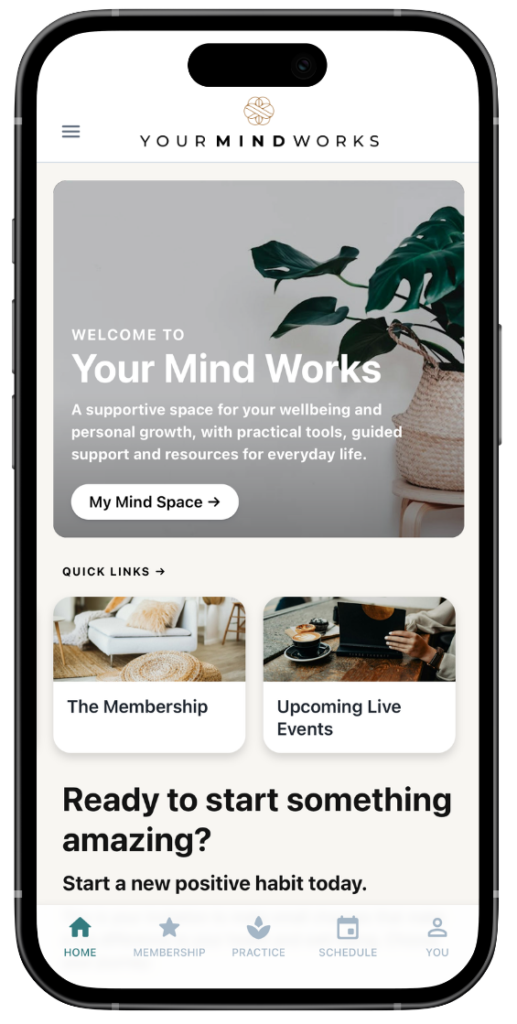
Our web-based app means you can easily access on any device with no app store download.
Additional resources, audios and more.
Schedule practices and exercises in your calendar
Your Personal Client Space
Join me for live group sessions
Library full of resources, mind tools, practices and audios.

Your Mind Works web-based app is available on all your devices. There’s nothing to download from an app store.
free guide to understanding chronic pain
LIVING Beyond Pain
Living with pain is difficult enough without also being left wondering why it is still happening or what you can do to help yourself. This free guide explains some of the reasons chronic pain can persist and offers practical ways to begin responding to it differently.
Inside, you’ll find:
- Pain science explained in a way that makes sense, including how chronic pain can develop and continue
- Why the nervous system can become more protective
- How sleep, stress, thoughts and emotions can affect pain
- Two practices and a guided audio to try for yourself
CONDITIONS I WORK WITH
Support for different chronic pain conditions
Chronic pain can be part of many different conditions. Although the causes and medical treatment may differ, therapy can help with the pain itself, its effect on everyday life and the difficult cycles that can develop around it.
Fibromyalgia
Fibromyalgia can involve widespread pain, fatigue, disrupted sleep and brain fog. Therapy can help you cope with pain, manage activity and rest, improve sleep and find ways to stay involved in your life without constantly pushing beyond your limits.
chronic back pain
Back pain can affect movement, sleep, confidence and everyday activity. Alongside appropriate medical or physical care, therapy can help reduce fear around pain, rebuild confidence in movement and manage the stress and tension that can make pain harder to cope with.
Chronic neck and shoulder pain
Ongoing neck and shoulder pain can leave you tense, cautious and worried about making things worse. Therapy can help you understand your response to pain, ease tension and gradually feel more confident in movement and daily activity.


Nerve pain (neuropathic pain)
Nerve pain can include sciatica, diabetic neuropathy, post-herpetic neuralgia and pain following nerve compression, surgery or injury. It may feel burning, stabbing, shooting or unusually sensitive to touch. Therapy does not replace treatment for the underlying cause, but it can help you cope with pain, reduce the fear and distress around it and feel less overwhelmed when symptoms are difficult.
Chronic fatigue and pain conditions
These conditions can involve pain, fatigue and symptoms that worsen after physical or mental activity. Therapy does not treat the underlying condition, but it can support sustainable pacing, sleep, difficult emotions and ways of living within your current capacity.
Arthritis
Arthritis includes different conditions, including osteoarthritis and rheumatoid arthritis, which can cause ongoing joint pain and affect movement, sleep, mood and everyday independence. Therapy can work alongside your medical care, helping you cope with pain, manage its emotional weight and feel more confident staying involved in the activities that are important to you.
Chronic migraine and headaches
Frequent headaches or migraines can create anxiety about when the next episode will happen and make planning difficult. Alongside medical care, therapy can help you manage stress, sleep, anticipatory worry and the wider effect pain is having on your life.

kind words
“
Learning about how chronic pain works was really helpful, and I finally felt things could get better.
Lucy made me feel at ease and explained everything simply so I understood. Learning about how chronic pain works was really helpful, and I finally felt things could get better. I’d been afraid to move because I always thought it would make things worse, even though my doctor told me to move more. I wish he had explained it properly back then, just knowing it was okay helped no end. The breathing exercises and relaxation helped a lot, and hypnosis really does help with the pain. The pain hasn’t gone, but it doesn’t control me like it did anymore. I’ve got my little box of tricks now and pacing properly so I don’t get laid up for days at a time, and can spot thoughts happening that aren’t good and do something about them. Thank you for all your help.
JL
“
I’ve always felt very relaxed, comfortable & confident.
Safe in your hands.
I felt really supported throughout and you explained everything really thoroughly and really clearly. I have definitely achieved what I wanted to, with a difference in my ability to relax and to be less worried about things. The biggest change for me is having the courage to be more assertive. I have found therapy has just helped massively. All the different aspects, working step-by-step to get a solution, getting clarity on my thoughts, the audios are just brilliant and the relaxation exercises have all been hugely beneficial too. I always felt very relaxed, comfortable and confident. Safe in your hands. Thank you. It has been amazing. I would absolutely recommend Lucy.
ST
“
I feel like the weight that was keeping me down has gone.
I have been experiencing quite a bit of pain and discomfort, and the practices and hypnosis have helped me release a lot of tension and especially the pain in my shoulder. I feel like the weight that was keeping me down has gone. I have been beating myself up about not doing enough, and feel I should always be doing something – so knowing it’s okay to just stop and rest was what I needed.
EJ
“
Knowing that my mind is just doing things that normal minds do has helped me a lot.
Understanding more about myself and knowing that my mind is just doing things that normal minds do has helped me a lot. I’m now much more patient with myself and know what to do when I start to feel anxious. It’s helped me make sense of so many things. I realised I had more ability to cope than I thought, but I needed help learning how to use those skills in the situations I needed them most. I feel much more confident, and learning self-hypnosis has been really helpful.
CW
frequently asked questions
No. Pain is real, whether or not scans or tests provide a clear explanation for it.
Pain is influenced by the body, brain, nervous system and what is happening in your wider life. Therapy works with factors such as fear, stress, sleep, activity and emotional wellbeing. It does not replace medical care or suggest that pain is imagined or “all in your head”.
Some people find that therapy or hypnotherapy helps reduce the pain itself. Others notice that pain feels less frightening, overwhelming or disruptive, and that they can cope better and do more of what they want to do.
Results vary, so I cannot promise that pain will disappear. Our work will focus on the changes that would make the greatest difference to your life.
It makes sense to feel cautious about trying again. Previous therapy may not have focused specifically on chronic pain or used an approach, structure or pace that worked for you.
RESTORE combines pain science, psychological therapy, hypnotherapy and practical support between sessions. A free consultation gives you a chance to understand how we would work before deciding whether it feels right for you.
Yes. Online chronic pain therapy is available across the UK, allowing you to join from a private space at home. In-person sessions are also available in North Warwickshire, within easy reach of Tamworth, Ashby-de-la-Zouch and Burton upon Trent.
During Cognitive Behavioural Hypnotherapy, you remain aware and involved. You can speak, move, pause or stop at any time, and hypnosis does not take away your control.
Hypnotherapy is suitable for many people, but not everyone. Before we begin, we’ll discuss your health, your pain and any current medical investigations to decide whether it is an appropriate approach for you.
RESTORE: Beyond Pain includes eight sessions: a 90-minute in-depth assessment followed by seven 60-minute sessions.
The 1:1 programme costs £990, payable in full or in three payments of £330. You’ll also receive access to the complete RESTORE programme inside the Your Mind Works app, including guided lessons, companion guides, exercises, tools and personalised audios.

book a free consultation The first step is a conversation.
A free 30-minute consultation gives us a chance to talk about how pain is affecting you and what you would like to change. You can ask questions, find out how I could support you and decide whether you would like to work together.

- Fayaz, A., Croft, P., Langford, R.M., Donaldson, L.J. and Jones, G.T. (2016) ‘Prevalence of chronic pain in the UK: a systematic review and meta-analysis of population studies’, BMJ Open, 6(6), e010364.
- Brinjikji, W. et al. (2015) ‘Systematic literature review of imaging features of spinal degeneration in asymptomatic populations’, American Journal of Neuroradiology, 36(4), pp. 811–816.
- Kirsch, I., Montgomery, G. and Sapirstein, G. (1995) ‘Hypnosis as an adjunct to cognitive-behavioural psychotherapy: a meta-analysis’, Journal of Consulting and Clinical Psychology, 63(2), pp. 214–220.
- Ramondo, N., Gignac, G.E., Pestell, C.F. and Byrne, S.M. (2021) ‘Clinical hypnosis as an adjunct to cognitive behaviour therapy: an updated meta-analysis’, International Journal of Clinical and Experimental Hypnosis, 69(2), pp. 169–202.
- McCracken, L.M. and Vowles, K.E. (2014) ‘Acceptance and commitment therapy and mindfulness for chronic pain: model, process, and progress’, American Psychologist, 69(2), pp. 178–187.
- Jensen, M. and Patterson, D.R. (2014) ‘Hypnotic approaches for chronic pain management: clinical implications of recent research’, American Psychologist, 69(2), pp. 167–177.
- Moseley, G.L. and Butler, D.S. (2015) ‘Fifteen years of explaining pain: the past, present, and future’, The Journal of Pain, 16(9), pp. 807–813.