











hypnotherapy for anxiety in warwickshire + online

Therapy for anxiety

Anxiety can keep you living ahead of yourself. Therapy can help you feel more present, build confidence and get back to doing the things anxiety has been getting in the way of.

hypnotherapy for anxiety

When your mind is always looking for what could go wrong.

Anxiety isn’t always loud. It can be the conversation you’re still replaying hours later, the decision that feels harder than it should or a sense that something could be about to go wrong.

You might appear to be coping while using enormous amounts of energy trying to stay ahead of everything. Or anxiety may already be affecting your confidence, choices, relationships and the things you feel able to do.

Anxiety is a normal part of being human. But when it begins making decisions for you, narrowing your life or leaving you constantly on alert, it can be difficult to know how to change things.

Therapy can help you understand what is keeping anxiety going and respond differently when it shows up, so it has less say over how you live.

When your mind works with you instead of against you, everything changes.

understanding anxiety

What is Anxiety?

Anxiety is one of the ways your mind and body try to protect you. It helps you notice possible threats, prepare for challenges and respond when something feels uncertain, risky or demanding.

The difficulty is that this protective response can remain active when there is no immediate danger. Everyday situations may begin to feel more threatening or urgent, while your mind keeps scanning for problems, replaying what has happened or trying to solve things that cannot be fully worked out in advance.

When this happens regularly, anxiety can take up more of your time, attention and energy than you want it to. Therapy can help you understand why this is happening and find new ways to respond, so you have more choice in what you do next.

Anxiety and stress

Stress and anxiety can feel very similar, but they aren’t quite the same.

Stress is usually connected to something you’re dealing with now, such as work demands, relationship difficulties, health concerns, money worries or an important conversation. Anxiety more often looks ahead, keeping you focused on what might happen or what could go wrong.

Both can leave you tense, restless, unable to switch off or struggling with sleep and concentration. They can also feed into one another: ongoing stress can keep your mind and body on alert, while anxiety can make everyday pressures feel harder to manage.

Therapy can help you understand what is driving both, respond differently when they show up and feel more able to handle the demands in front of you.

Anxious and exhausted

Anxiety can be exhausting, even when you appear to be coping. Your mind may spend much of the day scanning for problems, replaying conversations, preparing for what might go wrong or trying to stay one step ahead.

All that mental work uses energy. Over time, it can affect your sleep, concentration, memory, patience and ability to feel present. You may feel constantly tired while still finding it difficult to switch off.

Therapy can help you understand what is keeping anxiety active and learn ways to respond that demand less of your time and energy, leaving more of both for the rest of your life.

When does anxiety become a problem?

There isn’t a single point at which anxiety becomes a problem. What matters is how often it shows up, how much distress it causes and how much influence it has over your life.

You might notice yourself:

If anxiety is taking up more of your life than you want it to, therapy can help you understand what is happening and begin changing how you respond.

integrative therapy and hypnotherapy for anxiety

Working with anxiety, not against yourself

Therapy for anxiety isn’t about removing every anxious thought or making sure you always feel calm. We begin by understanding what is keeping anxiety active for you, then use approaches chosen for what you need.

Acceptance and Commitment Therapy (ACT) helps you respond differently to anxious thoughts and feelings, so they have less control over what you do. Rather than waiting for anxiety to disappear, you learn how to take action while making room for some discomfort.

Cognitive Behavioural Hypnotherapy (CBH) uses focused attention, imagery, suggestion and mental rehearsal to help you practise new responses to situations that currently feel difficult. This may include conversations, social situations, public speaking or moments of pressure.

Mindfulness helps you notice when anxiety is pulling you into worry, overthinking or predictions about what might happen. It gives you a chance to pause, settle and decide how you want to respond.

Life Beyond Anxiety

How we work together

therapy for anxiety in warwickshire + online

01

book a free consultation

A relaxed 30-minute call to tell me a little about what has brought you to therapy and what you’re hoping to change. You can ask questions and find out what the next steps would involve.

02

in-depth assessment

Your first full session is 90 minutes. We explore what you’ve been experiencing, the relevant parts of your history, how things are affecting your life and what you would like therapy to help you change.

03

a personalised plan

After your assessment, we agree what you would like to focus on and how we’ll work together. This gives our work direction while allowing us to review and adapt the plan as things change.

04

sessions to fit your life

We can meet online or in person in North Warwickshire, within easy reach of Tamworth, Ashby-de-la-Zouch and Burton upon Trent. Between sessions, your private space in the Your Mind Works app keeps your practices, audios and resources together and easy to return to.

Your Personalised Plan

What therapy can help change

Your plan will focus on how anxiety is affecting your life and what you would like to be different. Depending on what you need, therapy can help you:

Kind Words

therapy for anxiety life beyond anxiety

A six-session programme gives us time to understand how anxiety is affecting you, identify what is keeping it going and begin making changes that extend beyond the therapy room.

Your programme includes:

Session 1: In-depth assessment - 90 mins

We explore what has been happening, how anxiety is affecting your life and what you would like to change. This gives us a clear understanding of where to focus our work.

Sessions 2 - 6 - 60 mins each

We focus on what will help you most, building and practising ways to respond differently to anxious thoughts, feelings and situations. We’ll review what is changing as we go and adapt our work when needed.

Your programme also includes

  • A free 30-minute consultation
  • Sessions online or in person
  • Your own private space inside the Your Mind Works app
  • Personalised audios, exercises and resources for between sessions
  • Six months’ access to The Membership

six session programme: £600

This includes your 90-minute assessment followed by five 60-minute sessions. You can pay in full or in two payments of £300.

Booked individually, the same sessions would cost £750, so the programme saves you £150.

Prefer to book session by session?
A 90-minute assessment costs £150 and subsequent 60-minute therapy sessions cost £120 each.

your mind works app

SUPPORT between sessions

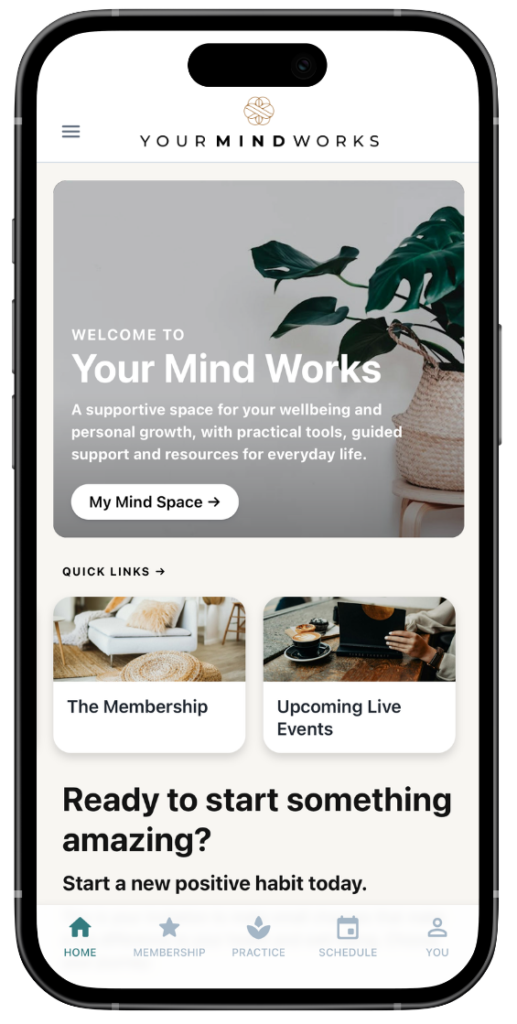
You’ll have your own private space inside the Your Mind Works app, where your personalised resources, guided audios, exercises, journal prompts and practices are kept together and easy to find.

Between sessions, you can return to the ideas we’ve discussed, practise new skills and listen to any audios I’ve chosen or created for you. If it’s helpful, you can also share reflections before we meet, allowing us to use our session time more effectively.

The app is there to support the work we’re doing, not give you more to keep up with. Use what helps, when it helps.

You’ll also receive six months’ access to The Membership, with live member sessions, the growing Practice Library and more ways to look after your wellbeing and keep growing.

The Your Mind Works app showing personalised therapy resources and guided audios

Our web-based app means you can easily access on any device with no app store download.

Additional resources, audios and more.

Schedule practices and exercises in your calendar

Your Personal Client Space

Join me for live group sessions

Library full of resources, mind tools, practices and audios. 

Your Mind Works web-based app is available on all your devices. There’s nothing to download from an app store.

Lucy Mundy

Your Mind Works

MSc, BSc (Hons) Psychology, HDipCBH, DipSMRB, GMBPsS, MNCIP (reg)

psychologist, integrative psychotherapist + coach

Psychology has been at the heart of my work for more than 25 years, helping people understand themselves, feel better and make changes that matter in their lives.

My approach is warm, engaging and down to earth. I’ll help you make sense of how anxiety is working in your mind and body, explain why some of the things that bring temporary relief can keep it going, and give you plenty of space to talk things through and ask questions.

We’ll practise new ways of responding together during sessions, and you’ll try them for yourself between sessions, so you can become confident using them when anxiety shows up. The aim isn’t for you to need therapy forever. It’s for you to understand yourself better, feel more able to handle what life brings and leave with skills you can continue using long after our sessions end.

Lucy Mundy, psychologist, integrative therapist, hypnotherapist and coach

frequently asked questions

Hypnotherapy can be helpful for anxiety when it is used as part of a wider therapeutic approach rather than as a standalone technique.

In Cognitive Behavioural Hypnotherapy, we first understand what is keeping anxiety going. Hypnosis, imagery, suggestion and mental rehearsal can then help you focus your attention and practise different ways of responding.

Yes. Therapy can help you understand why your mind keeps replaying conversations, searching for certainty or preparing for every possible outcome.

Rather than trying to force yourself to stop thinking, you can learn how to respond differently to worry and feel more able to handle uncertainty.

Anxiety can affect the body as well as the mind, causing tension, restlessness, digestive discomfort, headaches, disturbed sleep or panic-like sensations.

Therapy can help you understand why these sensations happen, feel less alarmed by them and learn ways to respond when they appear. New, severe or concerning physical symptoms should also be discussed with your GP.

During Cognitive Behavioural Hypnotherapy, you remain aware and involved throughout. Hypnosis doesn’t make you unconscious or take away your control, and you can speak, move, pause or stop at any time.

Hypnotherapy is suitable for many people, but not everyone. Before we begin, we’ll discuss your health, what you’re experiencing and whether it would be an appropriate approach for you.

It makes sense to feel cautious about trying again. Previous therapy may not have used an approach, focus or pace that worked for you at that time.

My approach includes clear psychological explanations, active skills practice and ways to continue between sessions. Your consultation gives you a chance to ask questions and understand how we would work before deciding whether to continue.

Yes. Online anxiety therapy is available across the UK, allowing you to join from a private space at home.

In-person sessions are available in North Warwickshire, within easy reach of Tamworth, Ashby-de-la-Zouch and Burton upon Trent.

Most people begin with six sessions: a 90-minute in-depth assessment followed by five 60-minute sessions. The programme costs £600, payable in full or in two payments of £300.

Some people may benefit from further sessions, depending on what they need. We’ll discuss this before beginning and review it together as we go.

You don’t need to wait until anxiety feels unbearable before asking for help.

If it is affecting your sleep, confidence, decisions, relationships, work or the things you feel able to do, it is reasonable to take it seriously. A free 30-minute consultation gives us a chance to talk about what is happening and what you would like to change.

The first step is a conversation.

A free 30-minute consultation gives us a chance to talk about what has brought you to therapy and what you would like to change. You can ask questions, find out more about how I work and discuss what the next steps could look like.

References

A-Tjak, J.G.L., Davis, M.L., Morina, N., Powers, M.B., Smits, J.A.J. and Emmelkamp, P.M.G. (2015) ‘A meta-analysis of the efficacy of acceptance and commitment therapy for clinically relevant mental and physical health problems’, Psychotherapy and Psychosomatics, 84(1), pp. 30–36. view here

Godoy, L.D., Rossignoli, M.T., Delfino-Pereira, P., Garcia-Cairasco, N. and de Lima Umeoka, E.H. (2018) ‘A comprehensive overview on stress neurobiology: Basic concepts and clinical implications’, Frontiers in Behavioural Neuroscience, 12.  view here

Hofmann, S.G., Sawyer, A.T., Witt, A.A. and Oh, D. (2010) ‘The effect of mindfulness-based therapy on anxiety and depression: A meta-analytic review’, Journal of Consulting and Clinical Psychology, 78(2), pp. 169–183. view here

Kirsch, I., Montgomery, G. and Sapirstein, G. (1995) ‘Hypnosis as an adjunct to cognitive-behavioural psychotherapy: A meta-analysis’, Journal of Consulting and Clinical Psychology, 63(2), pp. 214–220.  view here

Moran, T.P. (2016) ‘Anxiety and working memory capacity: A meta-analysis and narrative review’, Psychological Bulletin, 142(8), pp. 831–864.  view here

Ramondo, N., Gignac, G.E., Pestell, C.F. and Byrne, S.M. (2021) ‘Clinical hypnosis as an adjunct to cognitive behaviour therapy: An updated meta-analysis’, International Journal of Clinical and Experimental Hypnosis, 69(2), pp. 169–202.  view here

Valentine, K.E., Milling, L.S., Clark, L.J. and Moriarty, C.L. (2019) ‘The efficacy of hypnosis as a treatment for anxiety: A meta-analysis’, International Journal of Clinical and Experimental Hypnosis, 67(3). view here

Scroll to Top